
Berachain is under scrutiny after its CEO, Smokey The Bera, confirmed a refund clause for Nova Digital's $25 million Series B investment but challenged how the terms were portrayed in a recent report. The debate centers on whether Nova, a fund within Brevan Howard's crypto arm BH Digital, can reclaim its money for up to a year after Berachain's token launch.
The headline facts
- Smokey acknowledged a refund agreement but said public reporting got the framing wrong.
- Documents published by Unchained point to a 12-month window to request a refund after the Token Generation Event (TGE), which occurred on Feb. 6, 2025.
- BERA trades near $1, far below its $14.80 debut price and below Nova's reported $3 entry.
- It's unclear if other Series B investors received similar rights or protections.
What the documents show
Unchained said it obtained a side letter granting Nova Digital an unusual refund right on its purchase of BERA via a SAFT, or Simple Agreement for Future Tokens. The outlet linked to the letter, dated March 5, 2024, and reported that Nova could recover part or all of its $25 million "at any time" within 12 months after the TGE.
Unchained's coverage is here: unchainedcrypto.com. The posted document is here: side-letter.pdf.
The letter also says Berachain must return requested funds within five days of a refund request, according to Unchained.
What Berachain says
In an X post on Nov. 24, Smokey The Bera said the report was "incomplete" and "inaccurate." He said Nova is a "liquid-only" vehicle and asked for protection only if Berachain failed to launch the token and secure exchange listings.
He added that the letter wasn't designed to bail out a lead investor after launch or to close a deal with an otherwise unwilling backer, and that such clauses have precedent. At the same time, he said compliance rules limit how much the team can disclose and noted that Nova remains one of the project's largest token holders.
The point of tension
Those statements clash with what's in the posted letter. The side letter language—allowing a refund request any time within 12 months after the TGE—appears broader than a failure-to-launch safeguard. Unchained reporter Jack Kubinec told The Defiant the claim that the right applied only if BERA failed to launch is wrong, saying "it's all in the docs." The central questions now: Why was a post-launch refund right granted, and were other investors informed or covered via most-favored-nation (MFN) clauses?
MFN clauses promise investors equal or better terms if others receive them. Smokey said no Series B investors had MFN protections. Unchained reported that at least one investor had an MFN provision that would apply to the Series B, citing people familiar with the matter.
Market fallout and investor exposure
Price action has gone the other way since launch. BERA trades around $1, down more than 90% from its $14.80 debut. That's well below Nova's reported $3 entry price.
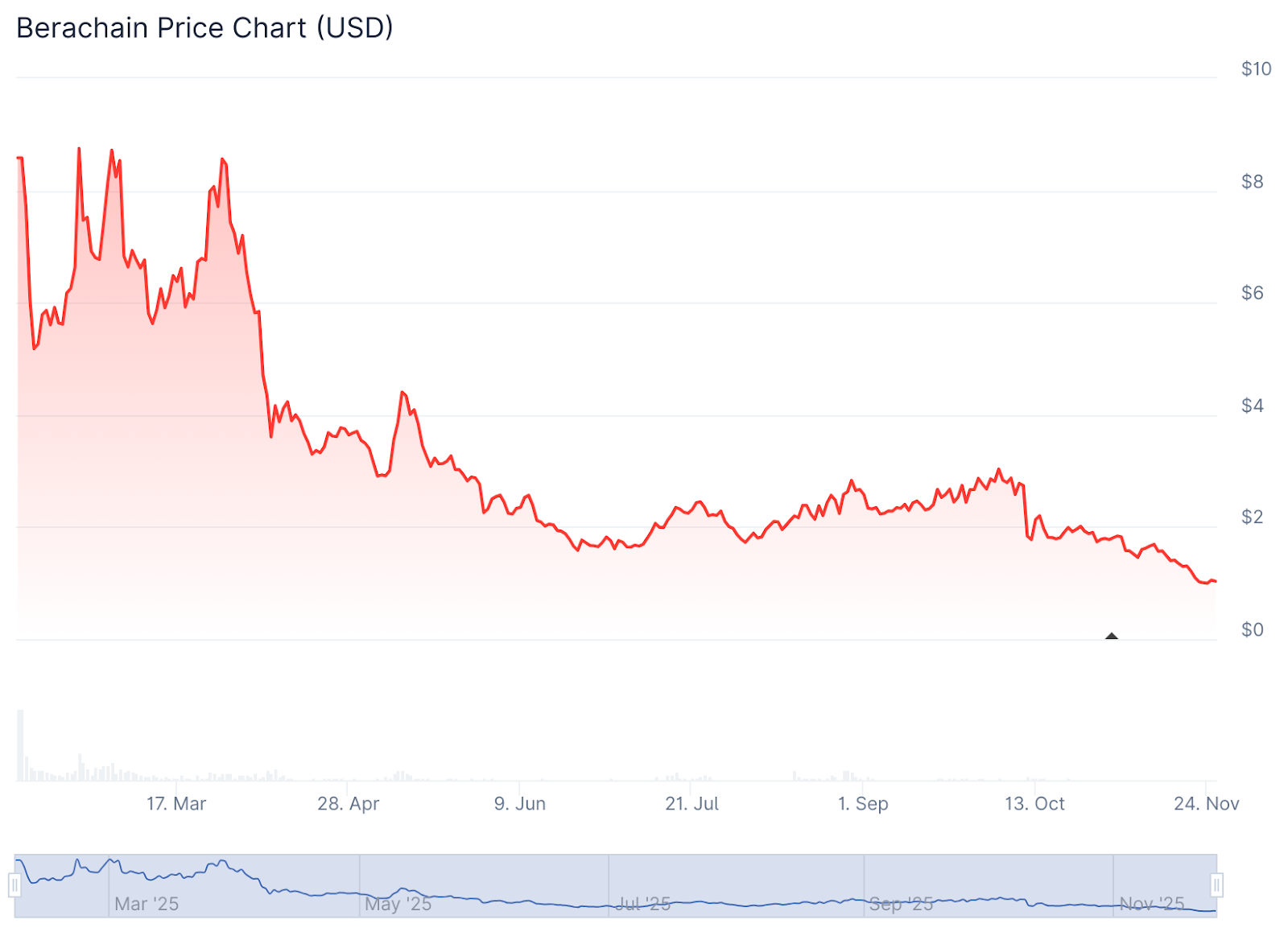
Framework Ventures is also in the red, reportedly buying more than 21 million BERA at an average of $3.42. If other backers—such as Polychain, Arrington Capital, and Tribe Capital—joined at a $1.5 billion valuation, they're likely underwater too. Berachain's fully diluted valuation hovers near $545 million.
Why this matters
- Retail optics: Refund rights can look like a safety net for big investors that small holders don't get, especially when prices fall.
- Deal precedent: If post‑TGE refunds become common, venture deals in crypto could start to resemble SPAC-style redemption options, changing risk-sharing norms.
- Disclosure gap: Unclear or private side letters make it hard for the market to price risk. Clearer disclosures could reduce rumor-driven volatility.
What remains unknown
- Has Nova Digital asked for any refund? The side letter would require Berachain to pay within five days of a request.
- Did any other investors receive similar rights or MFN coverage that would match Nova's terms?
- How will Berachain address investor concerns without breaching compliance restrictions?
Context: the project and the raise
Berachain, which began life as a bear-themed NFT collection, has raised at least $142 million since 2021 and reportedly hit a $1.5 billion valuation in its Series B. The TGE on Feb. 6, 2025, marked the start of BERA trading on exchanges.
In a March interview with Unchained, Smokey said that, in hindsight, the team "probably would not have sold as much of our supply to VCs." That comment underscores the current tension between venture investors seeking protections and communities that favor level playing fields.
Bottom line
Berachain's CEO says the refund clause was a narrow launch safeguard. The posted side letter reads broader than that. Until the team clarifies the discrepancy—and whether others had matching rights—uncertainty around BERA's cap table and investor incentives will linger.