
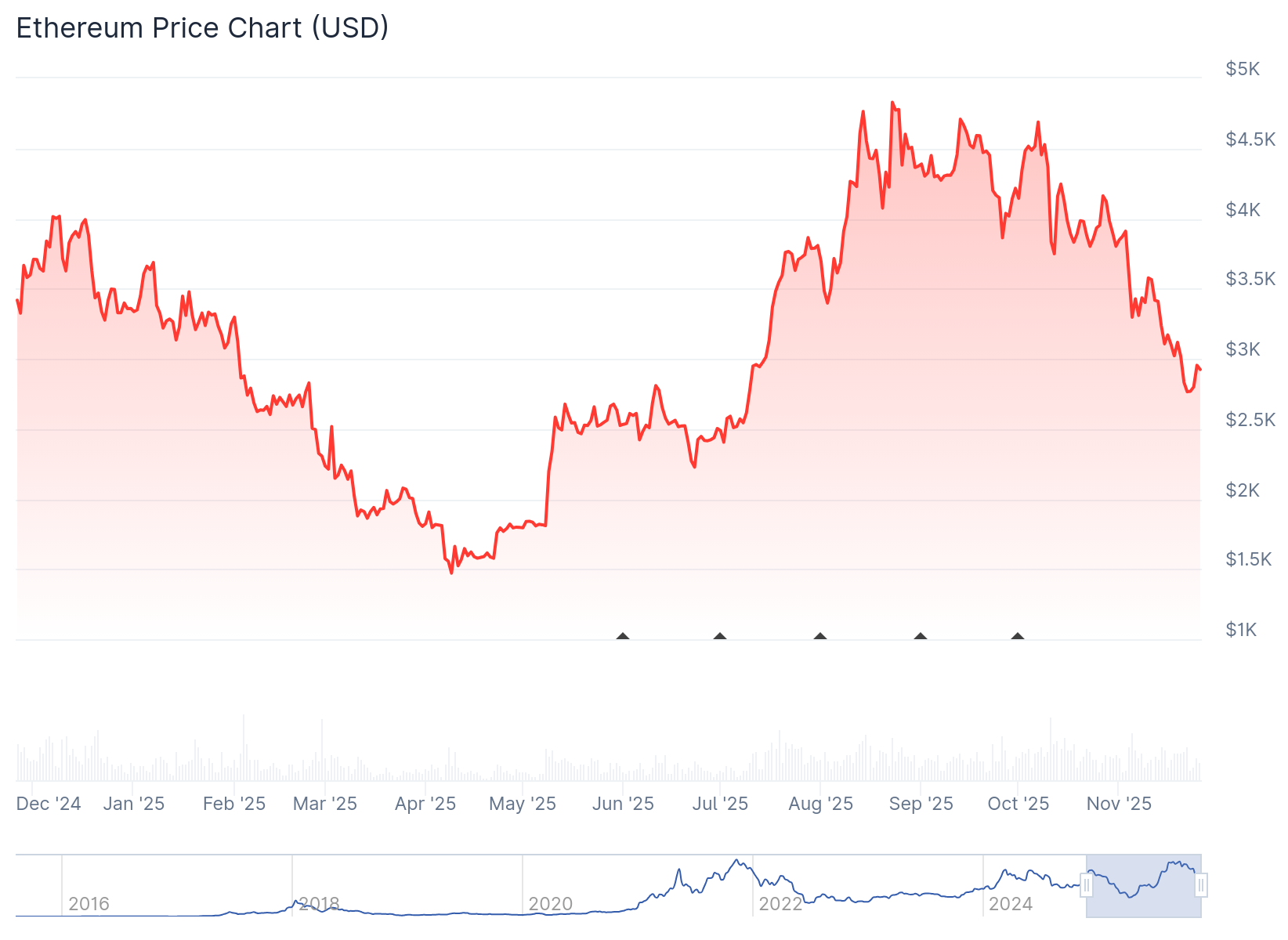
Ethereum fell below $3,000 this week, and that drop is stinging the growing class of public digital asset treasury (DAT) companies that loaded up on Ether (ETH) at higher prices. With ETH around $2,940, several of the largest corporate holders now sit on billions of dollars in unrealized losses.

ETH is down 28% for the month and about 41% from its Aug. 24 peak of $4,946, according to market data. The slide has turned attention to the balance sheets of these treasury-style firms and how they might react if prices stay weak.
Whos most exposed
BitMine Immersion (ticker: BMNR), chaired by Tom Lee, is the largest public ETH holder tracked by Strategic ETH Reserve. The dashboard shows BitMine with more than 3.6 million ETH, roughly 3% of total supply.

But BitMines own Treasury Dashboard indicates an average purchase price above $4,000. At todays levels, that leaves the company about $4.2 billion underwater on paper. In a Nov. 24 press release, Lee said the recent decline reflects impaired liquidity since October 10th and weak technicals. He estimated further downside of 5% to 7% but argued a potential supercycle in Ethereum could drive the next upswing. Days earlier, BitMine told the SEC it hired market-timing veteran Tom DeMark to help optimize its acquisition strategy.
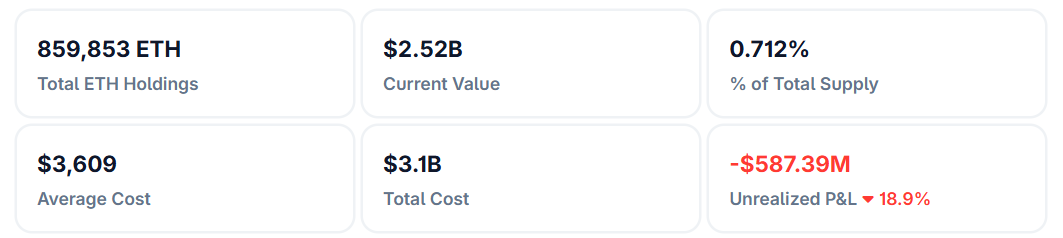
SharpLink Gaming is next in size. Chaired by Consensys founder Joseph Lubin, the company holds about 860,000 ETH at an average cost near $3,600, per CoinGecko. At current prices, SharpLink is roughly $587.4 million below break-even.
The Ether Machine, with around 497,000 ETH, has disclosed only some purchase prices. One filing detailed 10,605 ETH bought at roughly $3,781 in early August. Another announcement noted a 150,000-ETH in-kind commitment valued near $654 million, implying much of its stack was accumulated at higher levels in the high $3,000s to low $4,000s.
Early signs of selling
Some treasuries have started to trim. ETHZilla, the ninth-largest corporate ETH holder, said in late October that it sold about $40 million of ETH. The company used proceeds to repurchase roughly 600,000 shares for around $12 million under a $250 million buyback plan.
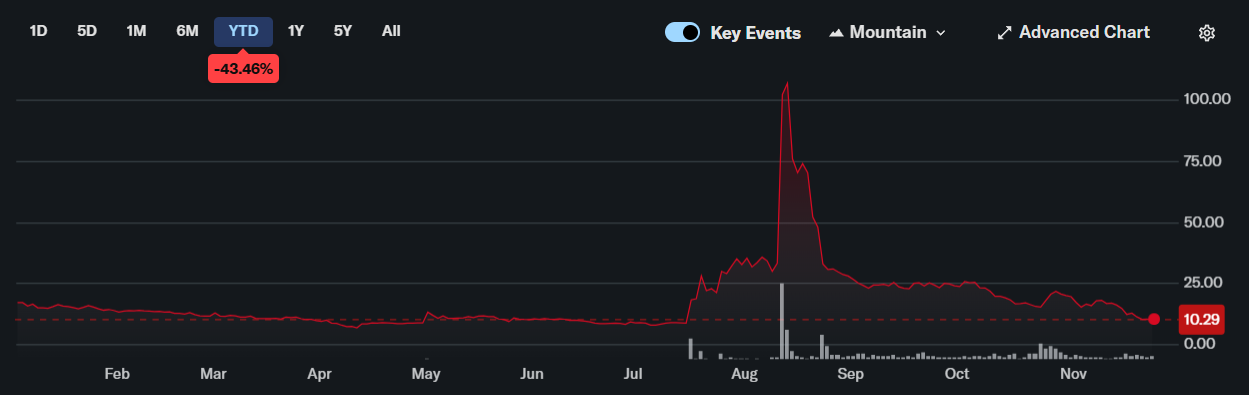
FG Nexus, the thirteenth-largest ETH treasury firm, disclosed selling 10,922 ETH in late October to fund a share repurchase. Shares of ETHZilla (ETHZ) are down more than 40% year-to-date, while FG Nexus (FGNX) has fallen nearly 90% this year.
Why this matters
Large treasury holders can amplify price swings. When prices fall, boards and investors often push for buybacks or cash cushions. That can force sales of crypto at weak levels, adding supply to the market. When prices rise, the same treasuries can become net accumulators, pulling supply off exchanges and fueling rallies.
These companies also concentrate risk. Many bought ETH well above todays price. If the market stays soft, more firms may sell to manage debt, buy back stock, or meet operating needs. If ETH recovers, their large positions could turbocharge earnings and share prices.
Key numbers
- ETH price: about $2,940; -28% month-to-date; -41% from the Aug. 24 all-time high of $4,946.
- BitMine Immersion: 3.6M ETH (~3% of supply); average cost above $4,000; about $4.2B unrealized loss.
- SharpLink Gaming: ~860,000 ETH at ~$3,600 average; around $587.4M below break-even.
- The Ether Machine: ~497,000 ETH; disclosed buys include 10,605 ETH at ~$3,781; 150,000 ETH in-kind commitment valued near $654M.
- ETHZilla: sold ~$40M of ETH; repurchased ~600,000 shares for ~$12M; stock down 40%+ YTD.
- FG Nexus: sold 10,922 ETH in late October; stock down nearly 90% YTD.
What to watch
- Further treasury updates from BitMine, SharpLink, and Ether Machine on average costs and liquidity planning.
- Whether additional DAT firms follow ETHZilla and FG Nexus in selling into weakness.
- Technical signals after BitMine engaged Tom DeMark, and whether any rally reduces pressure on high-cost holdings.
- Boardroom decisions: buybacks vs. balance-sheet defense if volatility persists.